ITMS - Coast GEm
Coastal regions can be hot-spots of greenhouse gas (GHG) production, but an exact quantification of emissions and controls remains difficult. In the Coast GEm, we estimate the greenhouse gas emissions from coastal waters and transitional waters, with a focus on the Elbe Estuary as most important contributary to the German Bight.
We investigate emissions of three most important greenhouse gasses, carbon dioxide, methane and nitrous oxide, in the coastal and marine environment, i.e. from the beginning of the estuary in Geesthacht, over the port in Hamburg, along the estuary and into the North Sea.
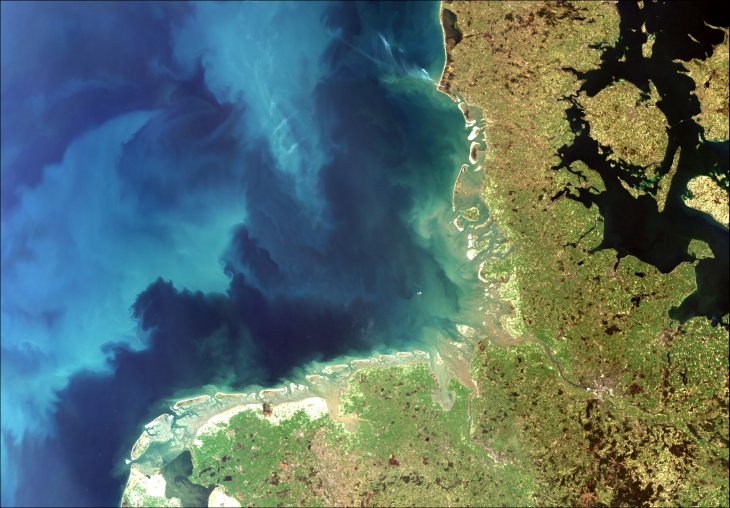
Satellite image of the North Sea and northern Germany (Source: ESA / Hereon)
Our approach combines existing flux data with continuous measurements (e.g., at the Tesperhude research platform) and dedicated research cruises in the German Bight. The resulting dataset contributes to improving national greenhouse gas inventories, where aquatic emissions are currently underrepresented.
The project is part of the Integrated Greenhouse Gas Monitoring System (ITMS), which aims to establish an operational framework for monitoring sources and sinks of CO₂, CH₄, and N₂O across Germany.
Learn more: Integrated Greenhouse Gas Monitoring System for Germany