
Successful 3D printing of bone regeneration structures made of magnesium
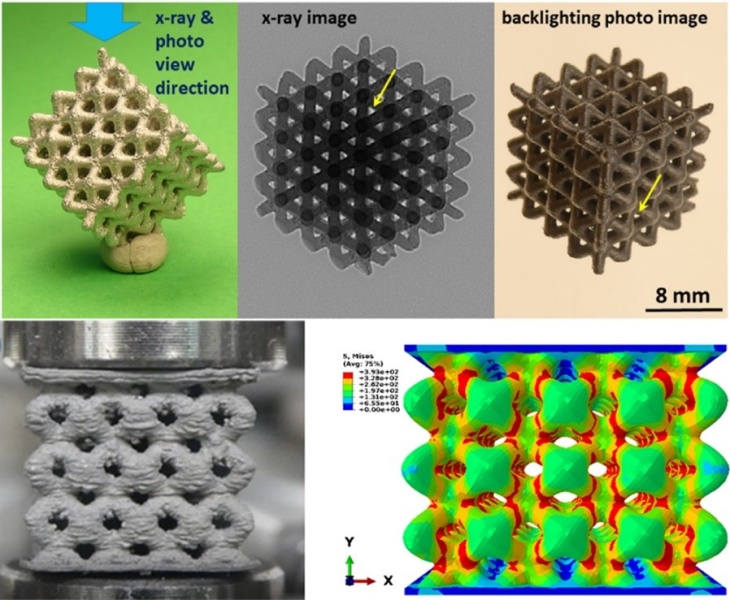
Mittels sinterbasiertem 3D-Druck hergestellte offene Gitterstrukturen aus Magnesium. Die experimentell gemessene mechanische Druck-Belastbarkeit stimmt mit Simulationsrechnungen überein.
Figure: Hereon / Martin Wolff
The use of open lattice structures can be useful for the treatment of bone defects caused by illness or accidents. They immediately stabilize the surrounding tissue and serve as a support for new bone formation during the healing process, similar to a trellis in a plant bed. The combination of degrading magnesium with the possibilities of 3D printing enables the patient-specific production of temporary implants adapted to the defect. Ideally, pure, healthy bone will replace the defect once the lattice has dissolved. In addition, 3D printing allows the mechanical properties to be precisely adapted to the required load-bearing capacity at the defect site through the choice of structure in order to further promote bone healing.
In this study, such a structure was successfully produced for the first time using sinter-based 3D printing (Fused Granular Fabrication) from a magnesium-gadolinium alloy. The experimentally determined mechanical properties were compared with the results of a computer simulation (finite element model) and showed good agreement. This provides the basis for geometrically and mechanically adapted bone regeneration materials.
Wolff et al., JMA 2023 11(8):2750-2762